
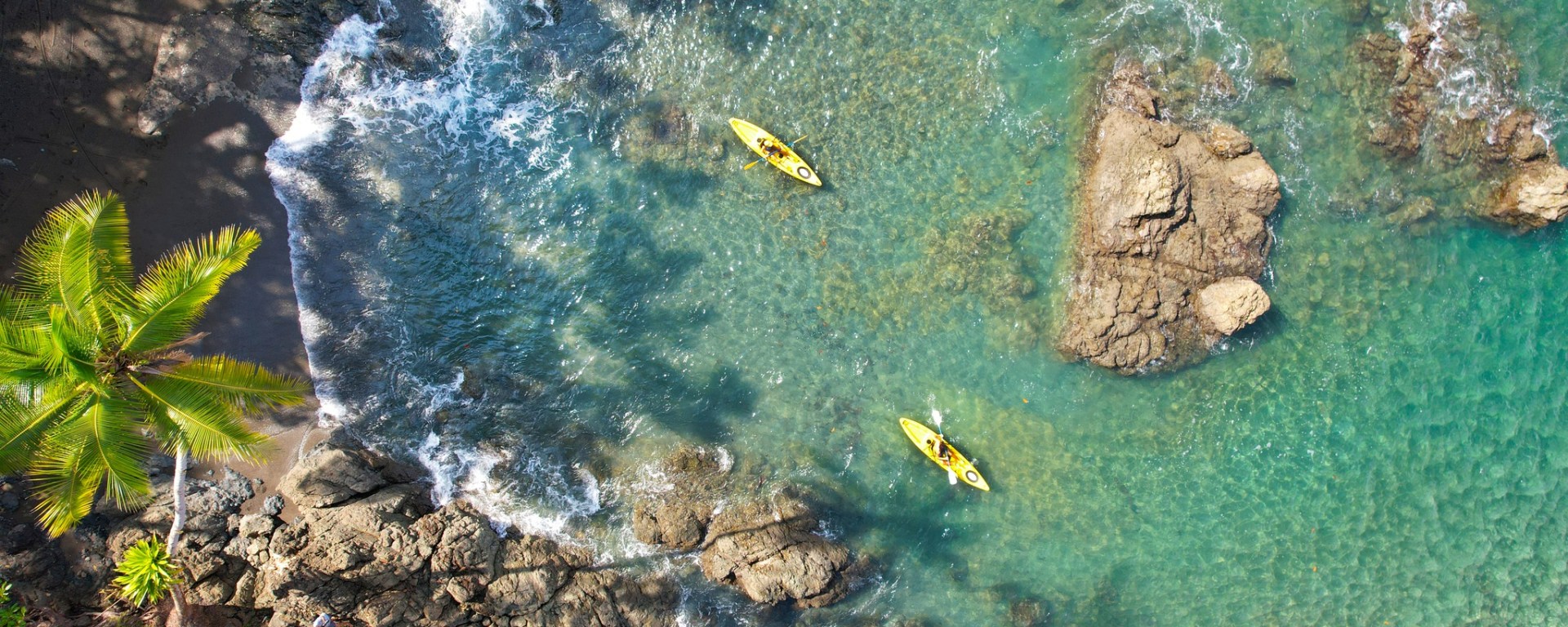
“Pura vida,” the Costa Rican catchphrase, philosophy and M.O., has never proven truer than at Corcovado Wilderness Lodge, a property occupying a remote swath of beach and rainforest on the Osa Peninsula bordering Corcovado National Park.
Corcovado Wilderness Lodge, on the Osa Peninsula, prioritizes sustainability, preservation, and passion for nature
Story by Shauna Farnell & Photos by Meredith Guinan
After visiting Costa Rica’s more touristy regions (a great experience), my partner and I felt compelled to travel to a less frequented corner of the country. The possibility of experiencing Corcovado Wilderness Lodge – a property overhauled last year by eco-conscious brand Soul Community Planet (SCP) – became a reality this November. Occupying 189 acres of private reserve adjacent to Corcovado National Park – the most biodiverse slice of the planet – the property proved adventurous even before we stepped foot onto its shores. And by step foot, I mean splashed out of the boat after it was maneuvered through a series of tight rocks and crashing waves into knee-deep ocean.
The wilderness Lodge, like the national park, can only be reached by boat. The route we chose took us on a small (12-seater) plane from San Jose to Drake Bay, where lodge staff picked us up to drive through shallow rivers to board the small boat the same way we disembarked – wading through ebbing waves. Another means of accessing the lodge involves driving to the riverside town of Sierpe and taking a 1.5-hour boat ride through the mangrove-lined river and along the coastline.

Arrival in Paradise
The beachfront section of the lodge’s property is home to a vibrantly green expanse of grass, fruit trees, flowering bushes and towering palm trees. As we arrived, the trees were swaying in the breeze and serving as the snacking ground for about 12 scarlet macaws. A miracle of natural color, these large, rainbow-flecked birds soared overhead throughout our five days in the area, nuzzled their life partners on branches and glided from tree to tree in perfect synchronicity.
A vehicle took us to the footbridge leading to our treehouse villa, one of 20 newly constructed during SCP’s recent overhaul of the property, which also included installing a massive solar garden and onsite water sanitation plant. We reached our rainforest villa on elevated paths through ancient trees and vibrant flowers where a series of butterflies, including the surreal blue Morpho – Costa Rica’s national emblem – fluttered magically.
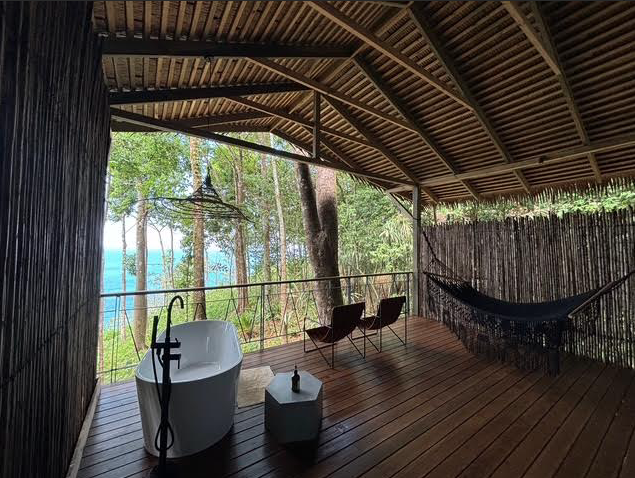
Our spacious villa was equipped with air-conditioning, toilet, shower, coffee station, outdoor bath and king-sized bed. Two walls were glass, including the sliding glass doors that led to the massive, elevated patio, featuring a hammock, chairs and outdoor bathtub. Providing front row access to our own stationary safari, watching the jungle and its creatures with the Pacific glistening in the background – was one of my favorite parts of the whole experience.
Environmental Preservation – A Priority
Like the rest of the country, more than 95 percent of which is run on renewable energy, the lodge prioritizes conservation and protecting its abundant surrounding landscapes. No single-use plastics are allowed on property, signs in the village remind visitors to turn off AC and lights when leaving and meals are comprised of locally sourced ingredients – including produce from the property’s gardens. The lodge strikes a balance between luxury and minimalism, serving small portions and repurposing all organic waste for compost. All meals are served at the three lodge restaurants, rotating depending on our activities.
The Lodge partners with local nonprofits – Nama Feline Monitoring Center, Innoceana Marine Conservation, Restor Forest Research Lab, Pristine Playa, Adopt A Coral and Blue Warriors. Visitors can learn all about the work, the unique species in the area and threats they face in a dedicated research bungalow. There’s even a state-of-the-art microscope where you can bring in items from the forest floor (we zoomed in on a tropical pinecone used as a “monkey brush”) and investigate their intricacies. Every employee exemplifies the pura vida philosophy, particular in their genuine passion for nature and wildlife, the access to which is the ultimate reason to come here.
Excursions include a guided tour of the park, accessed from the property’s own entrance. The park tour was the first of our planned activities, led by a guide named Michael, who’d grown up on the Caribbean side of the Peninsula and seemed to know the medicinal qualities of every single plant and tree we encountered as well as the sound and footprint of every animal and insect (Corcovado is home to more of each than anywhere else in the world – 13 tropical ecosystems). Honestly, compared to the wildlife we’d already seen up close on the lodge property, the tour was more educational than abundant in sightings.
Abundant Exotic Wildlife
Michael recognized the call of rare birds, somehow spotting a few amid the jungle’s density of leaves and vines. He pointed out a fist-sized Golden Silk Orb-Weaver spider, explaining its unique web-building skills and harmlessness. Howler and Spider monkeys occasionally screeched and leapt between 100-foot-high treetops of the thousand-year-old trees, whose roots, in some cases, grew together horizontally across a soccer-field distance, snaking over, under and around the surrounding minefield of other vegetation. We were told by guides of other groups we encountered – which, once we reached the main entrance of the park, seemed numerous compared to the human sparsity of our lodge property – that a puma had been sighted wandering the park’s trails, and was probably responsible for the uncharacteristic quiet of our surroundings. We did see an anteater – curled into a black and white ball on a high tree branch, it resembled a panda – as well as a throng of coatis (the racoons of Costa Rica) zigzagging across our path.

Upon returning to the villa, we saw another anteater shuffling through the leaves right in front of our patio and later, a whole swarm of peccaries – doe-eyed, bristly wild pigs – shuffling through the thick foliage right before our eyes.
As I was walking up to the bar area to refill my water bottle one afternoon, a staff member ran up and asked if I’d like to see the tapir – a large mammal resembling a baby elephant – that had been spotted eating grass near the beach. We watched it in awe for about 30 minutes as it peacefully ate and wandered.
Magical Marine Creatures
The other excursions included a snorkeling tour off the shores of Caño Island – an uninhabited chunk of land lying about 11 miles across the Pacific from Corcovado. Although the water was somewhat murky due to recent landslides caused by climate change, we saw an abundance of marine life, including reef sharks, schools of colorful parrotfish, triggerfish and even a couple of large sea turtles, who swam majestically from the ocean floor to the surface for intermittent breaths of air.

Arguably, our most magical wildlife encounters arrived on the whale watching tour. Shortly after leaving the shores of Corcovado, we encountered an enormous mother Humpback whale teaching its baby how to use its blowhole. We watched as the mother’s sleek back slowly emerged through the water like an island surfacing. We heard the chug of her breath through the spout of water shooting from her head. She would then roll forward like a giant wheel turning. A second or two later, the baby would emerge and imitate this routine. Our guide – a young and passionate marine biologist named Fabiola – explained that the mother was swimming under the young whale, pushing it upward to guide it through this sequence.

After we left the scene, only a few minutes passed before our next marine show. A pod of spotted dolphins suddenly appeared, leaping and weaving around the boat. We also witnessed an intermittent airshow of brown boobies flying low and sweeping up sardines, as well as a rare Nazca booby that traveled to the area from the Galapagos.
One of the most surreal experiences on the trip was coming across a pack of false killer whales – a type of orca that looks like a large dolphin, but which, in fact, feeds on dolphins as well as other large fish. In fact, one of the whales had a large tuna in its mouth, which we could clearly see as it unbelievably continued to swim alongside, and under and around our boat. Several of its friends joined it, as if guiding us somewhere. Fabiola tentatively put her GoPro camera under water to film for a few seconds. One of the whales approached, pausing in front of her hand, almost as if it were communicating.
The Grand Finale
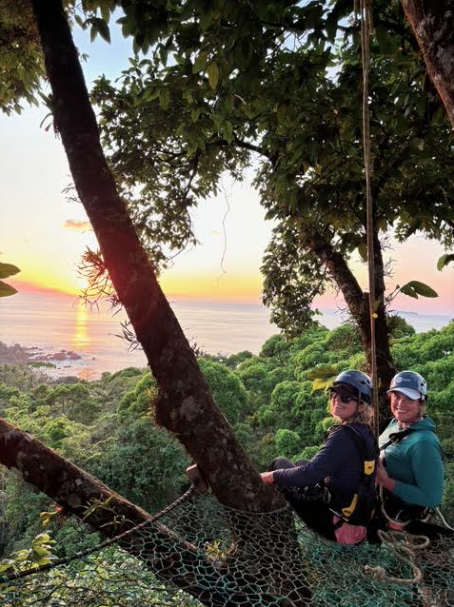
The grand finale was watching a sunset from 150 feet off the ground in a tree net. Using a winch harness on a long, dangling rope, we ascended an ancient Baco tree. Focusing on the canopy overhead rather than on the jungle floor becoming smaller and smaller as the winch hummed up the rope, we reached the net and got the monkey’s eye view of the surroundings. From here, we watched the sunset over the ocean while sipping a local beer with our two guides before harnessing back onto the rope and repelling down.
As time closed in and I left the property, the purity of the natural world around me had settled my soul. The experience is the ultimate getaway for nature lovers. It provides a true reminder of the miracle of life in its countless, stunningly beautiful iterations. This is pura vida at its best.
www.corcovadowildernesslodge.com
Featured Image Courtesy of Corcovada Wilderness Lodge all other images by Meredith Guinan
Story Sponsor

Mountain Women Magazine | A magazine for Women filled with a passion for living life in the Colorado Rocky Mountains and beyond.
A MTN Town Media Productions Passion Project – Copyright ©2025 MTN Town Media Productions all rights reserved.
 Mountain Women Magazine